
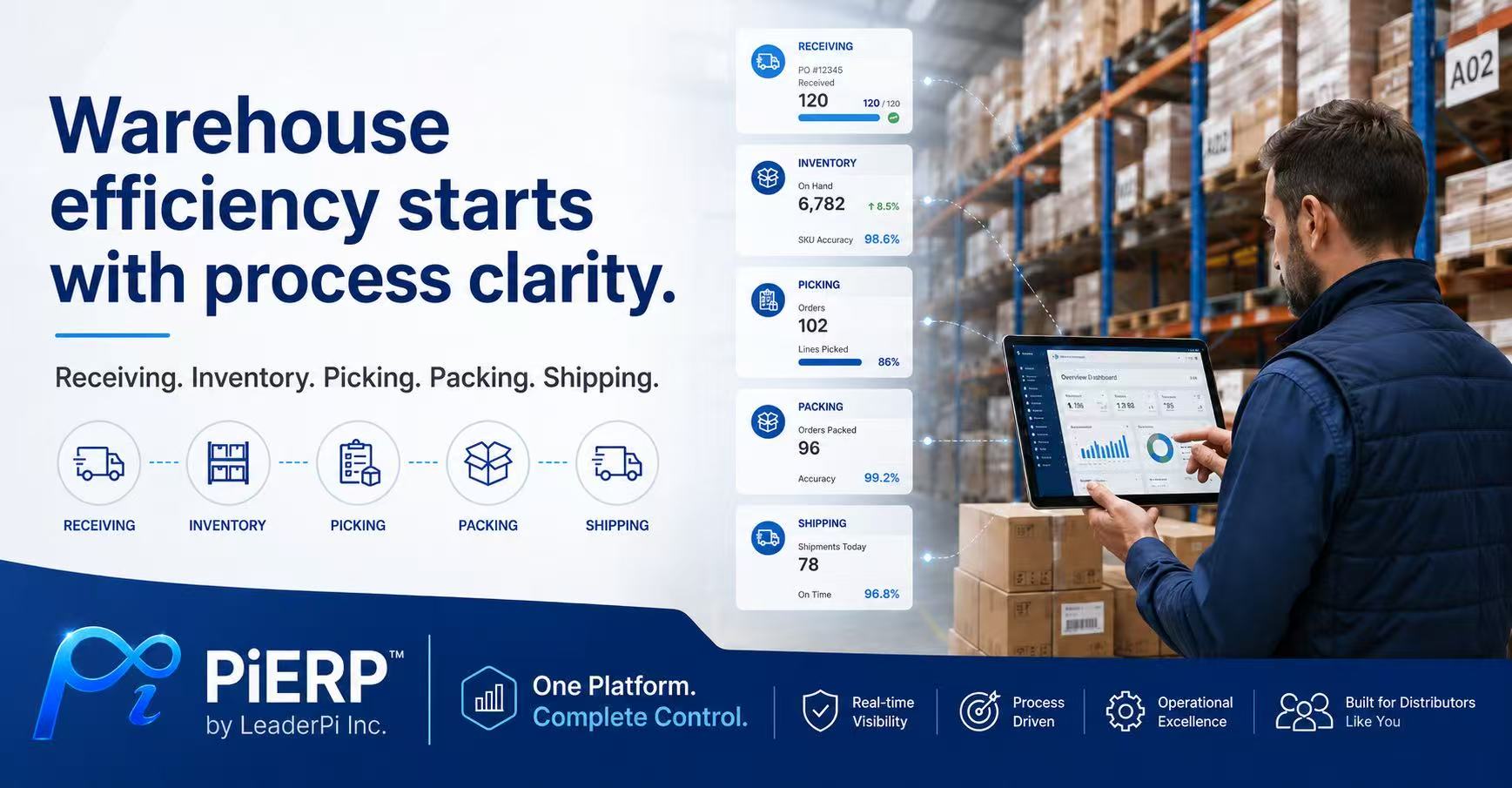
Warehouse Efficiency Starts with Process Clarity
For many small and mid-sized distributors, warehouse efficiency depends heavily on experienced people.
Someone knows where the parts are.
Someone remembers which order is urgent.
Someone understands how receiving should be handled.
Someone knows what needs to be shipped today.
This works for a while. But as the business grows, the warehouse becomes harder to manage through memory, phone calls, spreadsheets, and manual follow-ups.
Real warehouse efficiency does not come from asking people to work harder. It comes from making the process clearer.
Why Warehouse Teams Lose Efficiency
Warehouse teams often deal with many moving parts at the same time:
- Purchase orders arriving from suppliers
- Customer orders waiting to be picked
- Backorders that need attention
- Inventory that may not match the system
- Packing and shipping deadlines
- Staff members asking for updates
- Sales and service teams needing answers quickly
When the process is unclear, small delays become bigger problems.
A received item may not be updated in the system right away.
A picked order may sit without being packed.
A backordered part may not be followed up on.
A customer may ask for an update that no one can answer confidently.
These problems are not always caused by poor work. Many times, they happen because the system does not give the team enough visibility.
ERP Should Support Warehouse People, Not Replace Them
Experienced warehouse staff are extremely valuable. They understand the products, the customers, the exceptions, and the daily pressure of operations.
A good ERP system should not replace that experience. It should support it.
The right system helps warehouse teams work with:
- Clear receiving records
- Accurate inventory visibility
- Organized picking workflows
- Better packing control
- More reliable shipping status
- Fewer repeated questions
- Less manual searching
- Better accountability across the team
When information is visible in one place, the team can move faster with fewer mistakes.
The Importance of Receiving, Picking, Packing, and Shipping
Warehouse operations are not just one activity. They are a chain of connected steps.
Receiving affects inventory.
Inventory affects order availability.
Picking affects packing speed.
Packing affects shipping accuracy.
Shipping affects customer satisfaction.
If one step is unclear, the entire process slows down.
That is why distributors need more than a basic order list or spreadsheet. They need a system that connects the full workflow from purchase order receiving to final shipment.
How Process Clarity Improves Control
Clear warehouse processes help companies answer important questions quickly:
- What arrived today?
- What is available to sell?
- Which orders are ready to pick?
- Which shipments are delayed?
- Which items are backordered?
- Where is the bottleneck?
When these answers are visible, managers can make better decisions. Staff can focus on execution instead of searching for information. Sales and service teams can give customers more accurate updates.
The result is not just faster work. It is better control.
How PiERP Helps Distributors
PiERP is designed for small and mid-sized distributors that need better visibility across daily operations.
With PiERP, teams can manage key workflows such as:
- Purchase orders
- Receiving
- Inventory control
- Sales orders
- Picking
- Packing
- Shipping
- Backorders
- Customer records
- Operational reporting
The goal is simple:
Less guessing.
Less searching.
Less duplicated work.
More visibility for the whole team.
Warehouse efficiency is not only about speed. It is about accuracy, accountability, and control.
Want Better Visibility Across Your Warehouse Operations?
PiERP helps distributors bring receiving, inventory, picking, packing, shipping, and order management into one connected system.
Book a demo to see how PiERP can help your team work with more clarity and control.
Book a demo